Spot the Lies: A Practical Guide to Detecting Fake PDFs Quickly
about : Upload
Drag and drop your PDF or image, or select it manually from your device via the dashboard. You can also connect to our API or document processing pipeline through Dropbox, Google Drive, Amazon S3, or Microsoft OneDrive.
Verify in Seconds
Our system instantly analyzes the document using advanced AI to detect fraud. It examines metadata, text structure, embedded signatures, and potential manipulation.
Get Results
Receive a detailed report on the document's authenticity—directly in the dashboard or via webhook. See exactly what was checked and why, with full transparency.
Understanding the Anatomy of a PDF and How Tampering Shows Up
A PDF is more than a static image; it is a layered container that can include text, embedded fonts, images, annotations, form fields, attachments, and metadata. To reliably detect fake PDF artifacts, it helps to understand those internal layers. Metadata fields such as author, creation and modification dates, producer and application identifiers often reveal inconsistencies when a document has been edited or reconstructed with different tools. For example, a contract claiming to be created years ago but showing a recent creation timestamp is an immediate red flag.
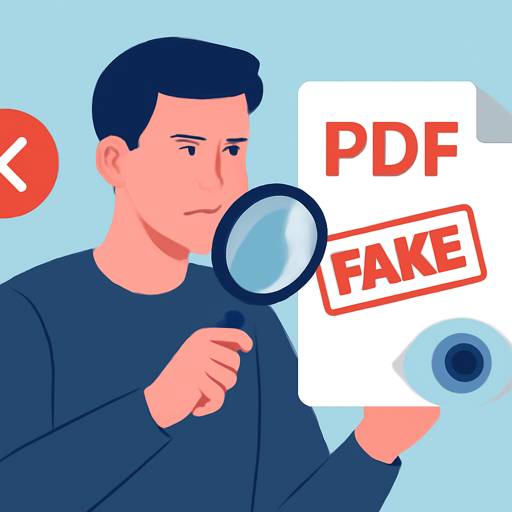
Visual anomalies are also telling: inconsistent fonts, mismatched kerning, strange spacing, or rasterized text where vector text should be are signs of manipulation. Scanned documents converted to PDF may show compression artifacts or layer mismatch if elements were copy-pasted. Embedded images often hide evidence too — a pasted signature saved as a low-resolution raster image can appear visually similar to an authentic signature but will fail verification when examined at pixel and vector levels.
Other areas to examine include annotations and form fields. Hidden annotations or fields can conceal changes or trackable edits. Cross-referencing embedded fonts and resource dictionaries can surface substitutions: a font substituted during editing might cause character differences or glyph mismatches. Finally, digital signatures and certificates provide strong evidence of authenticity when properly implemented; however, fake signatures can be inserted as images. Verifying the cryptographic signature and its trust chain is crucial — a valid certificate from a trusted authority and an intact hash confirm integrity, while absent or invalid chains suggest tampering.
Automated Detection: How AI and Tools Analyze PDFs to Reveal Fraud
Automated systems combine rule-based checks, heuristic analysis, and machine learning to surface suspicious PDFs in seconds. Core checks include metadata validation, structural integrity scans, and signature verification. Rule-based checks flag obvious inconsistencies, such as mismatched timestamps, inconsistent file producers, or unusual embedded objects. Heuristics look for patterns commonly associated with forgeries: repeated image reuse, suspiciously flattened layers, or text that has been converted to an image. Machine learning models trained on large corpora can detect subtler anomalies like improbable language patterns, layout deviations, or micro-level compression differences.
Advanced systems also perform pixel-level forensic analysis to detect cloning, copy-paste edits, or localized resampling. By comparing noise patterns, compression blocks, and edge artifacts, an algorithm can identify where a signature or clause was inserted. Natural language processing (NLP) helps spot semantic inconsistencies: dates that don’t align with context, contradictory clauses, or unusual phrasing that signals template misuse.
Integration and workflows matter: upload options (drag-and-drop, cloud connectors, API access) make it easy to ingest documents from multiple sources while preserving provenance. When rapid verification is needed, an automated pipeline will produce a transparent report listing all checks and the rationale behind any flags. For organizations seeking a turnkey solution to detect fake pdf, these tools can be embedded into intake systems, enabling real-time screening without manual review. Always pair automated findings with human review for high-stakes documents; automation surfaces likely issues, while experts contextualize and make final determinations.
Best Practices, Case Studies, and Real-World Examples of PDF Fraud Detection
Real-world cases illustrate the range of PDF fraud: forged invoices used in business email compromise, altered academic transcripts, and counterfeit legal agreements. In one notable scenario, a fraud ring sent payment requests with visually convincing logos and signatures; automated metadata analysis revealed that all invoices were generated from the same obscure PDF generator and shared identical internal IDs, exposing the scheme. In another case, an academic transcript circulated with a high-profile alumnus’s name contained glyph substitutions — certain numerals were replaced with visually similar characters from different Unicode blocks to evade simple string-matching checks. A combined forensic approach flagged the Unicode anomalies and traced the edits to a specific editing tool.
Best practices to reduce exposure include implementing strict document intake policies, requiring signed PDFs with verified digital certificates for critical transactions, and maintaining secure cloud storage with access logs to preserve provenance. Train staff to spot common red flags: mismatched letterhead elements, signatures that do not align with signature stamps, and iterative edits visible in version histories. Use layered defenses — technical screening, manual review for exceptions, and legal verification for high-value agreements.
For organizations processing large volumes of documents, build an audit trail. Capture source metadata (upload origin, IP address, timestamps) and retain original files. When a suspicious document arises, this provenance data often provides decisive context. Case studies consistently show that combining automated forensic tools with human expertise and robust intake controls yields the highest detection rates, minimizes false positives, and helps organizations respond quickly and confidently to document fraud.

Kumasi-born data analyst now in Helsinki mapping snowflake patterns with machine-learning. Nelson pens essays on fintech for the unbanked, Ghanaian highlife history, and DIY smart-greenhouse builds. He DJs Afrobeats sets under the midnight sun and runs 5 km every morning—no matter the temperature.